
Why Get Assessed as an Adult? Understanding Late Diagnosis
- georgia3817
- 2 days ago
- 3 min read
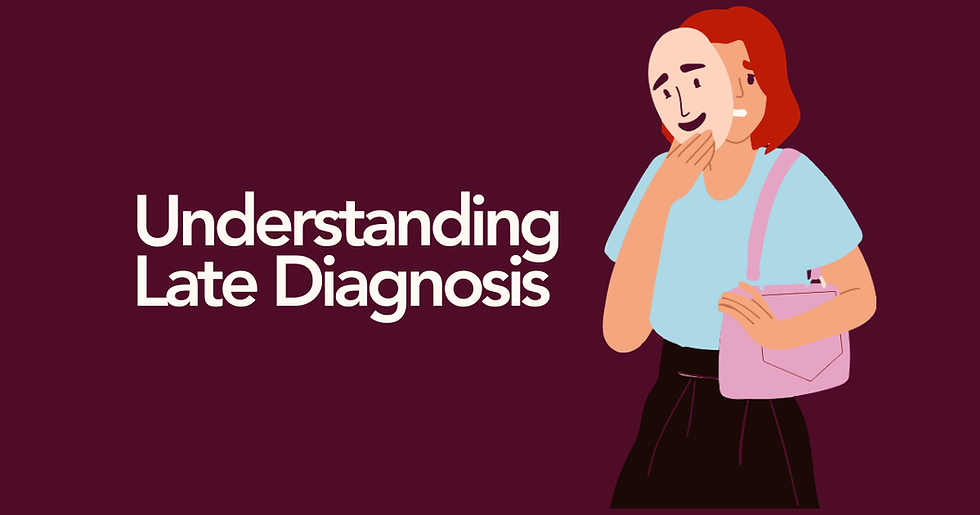
For a lot of adults, the idea of getting assessed for ADHD or Autism comes with a question sitting underneath it: why now, and why does it matter at this point in my life? If you've made it this far without a diagnosis, it can feel like maybe you don't really need one. But for many people, a late diagnosis isn't about starting from scratch. It's about finally making sense of a lifetime of things that never quite added up.
Why diagnosis often gets missed earlier in life
There are a lot of reasons someone might reach adulthood without ever being assessed. Masking, the process of consciously or unconsciously hiding traits to fit in, is a big one, and it's especially common in people who were praised for being "quiet," "sensitive," or "a bit much" rather than recognised as neurodivergent.
Diagnostic criteria have also historically been built around how ADHD and Autism present in young boys, meaning many women, gender diverse people, and people with strong coping strategies were simply never assessed as children. On top of that, comorbid conditions like anxiety or depression can sometimes overshadow underlying ADHD or Autism, leading to years of treatment that addresses symptoms without ever getting to the root cause.
What changes with a diagnosis
Getting assessed as an adult can open doors that might not have been available otherwise. This might include access to further Medicare psychology or OT support, workplace or study adjustments, medication options if that's something you want to explore, and eligibility for NDIS support in some cases. But often, just as significant is the internal shift. Having language for your experience, and evidence that it's real, can be genuinely life changing.
The emotional side of a late diagnosis
It's common to feel a mix of things after a late diagnosis, sometimes all at once. Relief, at finally having an explanation. Grief, for the support you didn't get earlier, or for years spent thinking you just weren't trying hard enough. Frustration, if it feels like it should have been picked up sooner. Validation, in realising you were never lazy, difficult, or too sensitive, your brain has just been working differently the whole time.
All of these reactions are valid, and none of them mean you're doing it wrong.
Why this is especially common in women
Late diagnosis isn't spread evenly across genders, and there are some real, well-documented reasons why women and AFAB people in particular tend to be identified much later in life, if at all.
One major factor is history. Autism was actually an exclusion criterion for an ADHD diagnosis until 2013, meaning clinicians weren't permitted to diagnose the two conditions together. That single rule meant an entire generation of adults, especially women, missed out on accurate diagnosis simply because the systems weren't built to catch them.
Diagnostic criteria themselves have also historically been developed around how ADHD and Autism present in young boys. Traits like forgetfulness, emotional sensitivity, restlessness, or social anxiety in girls were often written off as personality quirks rather than recognised as neurodevelopmental. On top of that, women tend to be diagnosed with autism later than men, with most receiving their diagnosis in adulthood rather than childhood.
Masking plays a particularly significant role here too. Research shows that better masking makes a diagnosis easier to miss, and higher academic ability is linked to stronger masking skills, meaning some of the most capable, high-achieving girls and women were often the ones who slipped through completely unnoticed. Many describe becoming so practised at hiding their needs that they eventually convinced themselves they didn't have any, until burnout eventually caught up with them.
That burnout often looks different too. Late-diagnosis burnout is frequently described as a kind of pervasive exhaustion and loss of skills, driven by years of trying to meet expectations that were never designed with their brain in mind. Many describe the diagnostic process itself as both deeply validating and genuinely destabilising all at once, needing real support to make sense of a lifetime reframed.
You don't need to have struggled "enough" to get assessed
One thing that stops a lot of adults from seeking an assessment is the belief that their struggles aren't significant enough, or that they've coped well enough that it can't really be ADHD or Autism. But coping doesn't mean it isn't real, and it doesn't mean it isn't costing you energy behind the scenes. If you've ever wondered whether an assessment might explain things, that's reason enough to explore it.
Ready to find some answers?
If you've been considering an assessment, our team offers neuroaffirming ADHD and Autism assessments for adults across Australia via telehealth. Join our waitlist to take the first step toward finally understanding your brain.


Comments